
Playbook: Action Futures
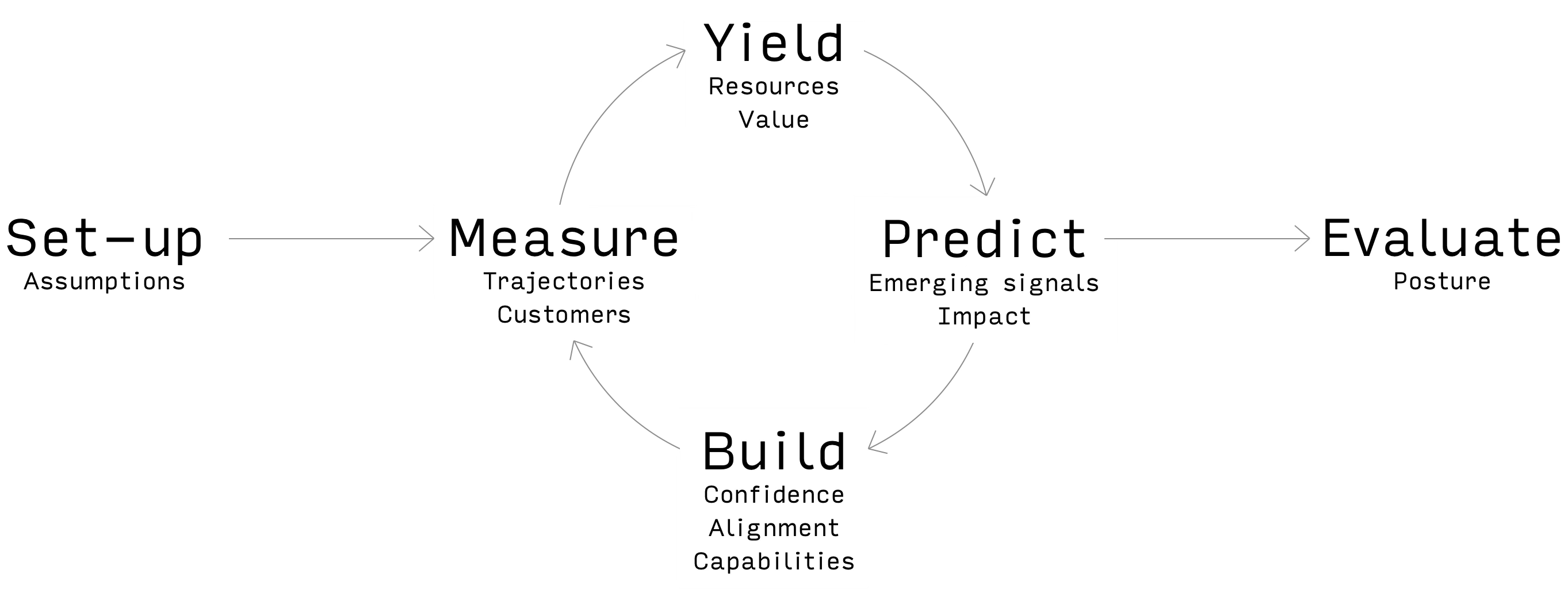
The Action Futures Framework activates decision rehearsal through cooperative game mechanics, that reveal organizational value, alignment, confidence, and impact, while navigating uncertain futures. It uses play and causality to test how adaptable their strategies are, and offers insight into what kind of organization they might become.
|
Set-up
The game begins with setting-up the organization’s current ASSUMPTIONS.
Place the PIVOT tile in the center, and place 3 RESOURCES on the organization’s MISSION card.
|
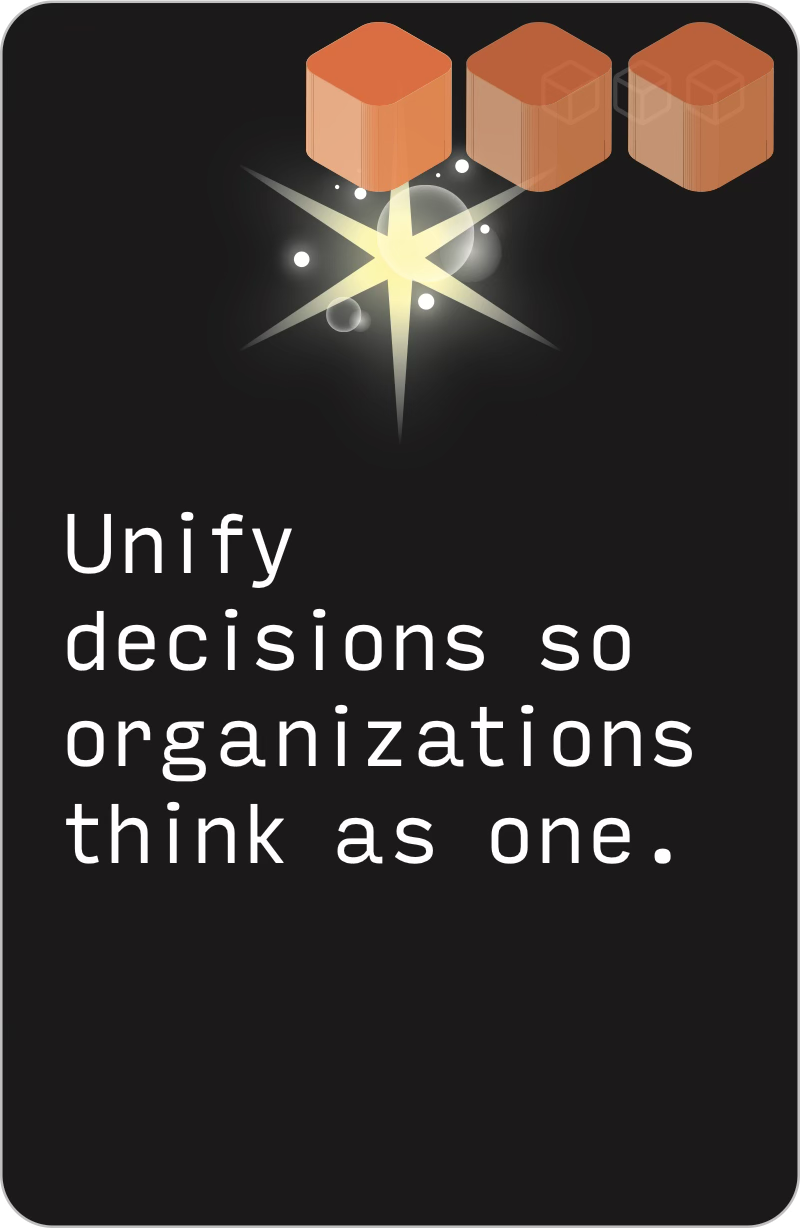
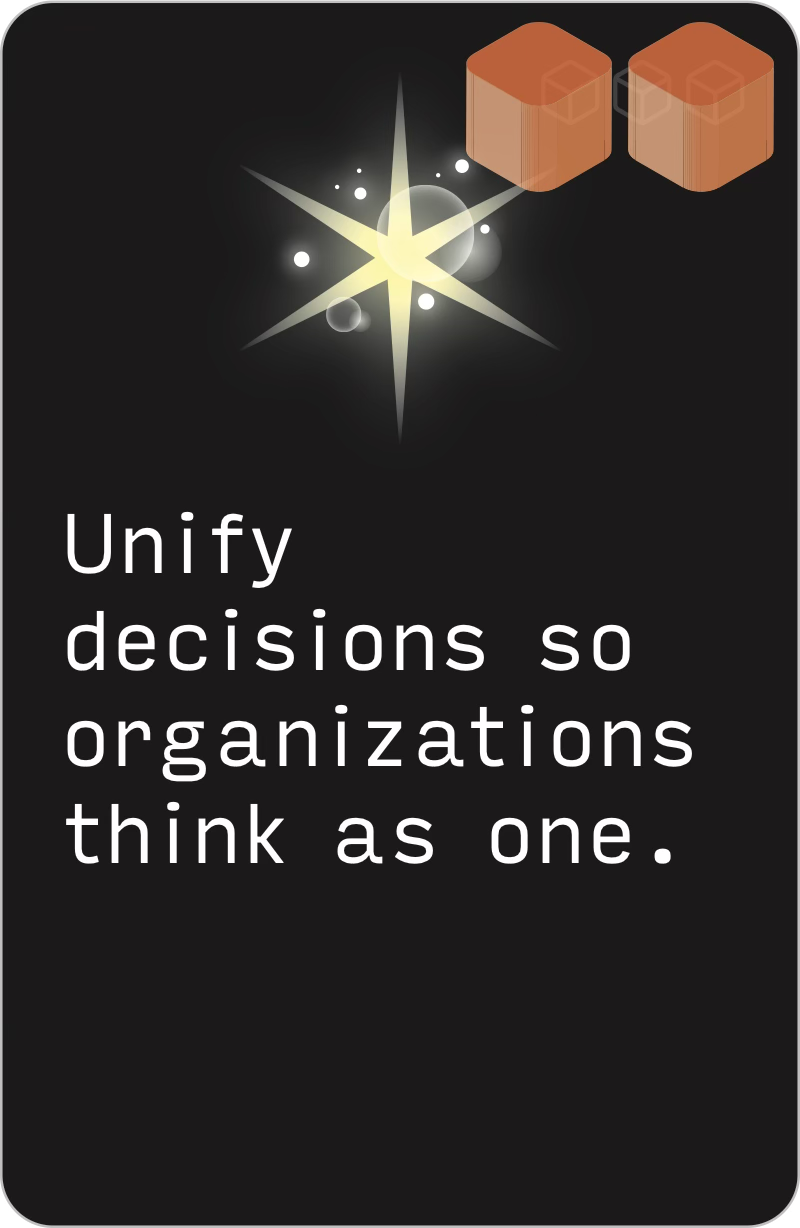
MissionThe MISSION card captures the organization’s continuity of purpose across time, and transcends any TREND or SIGNAL in a shifting future landscape. During play, if any 3 participants agree that a decision violates their MISSION integrity, they must remove a RESOURCE from the MISSION. Participants can recover MISSION integrity through CAPABILITIES. MISSION integrity affects alignment, which is one of the 4 dimensions used to measure the organization’s POSTURE. |
|
|
|
Trends
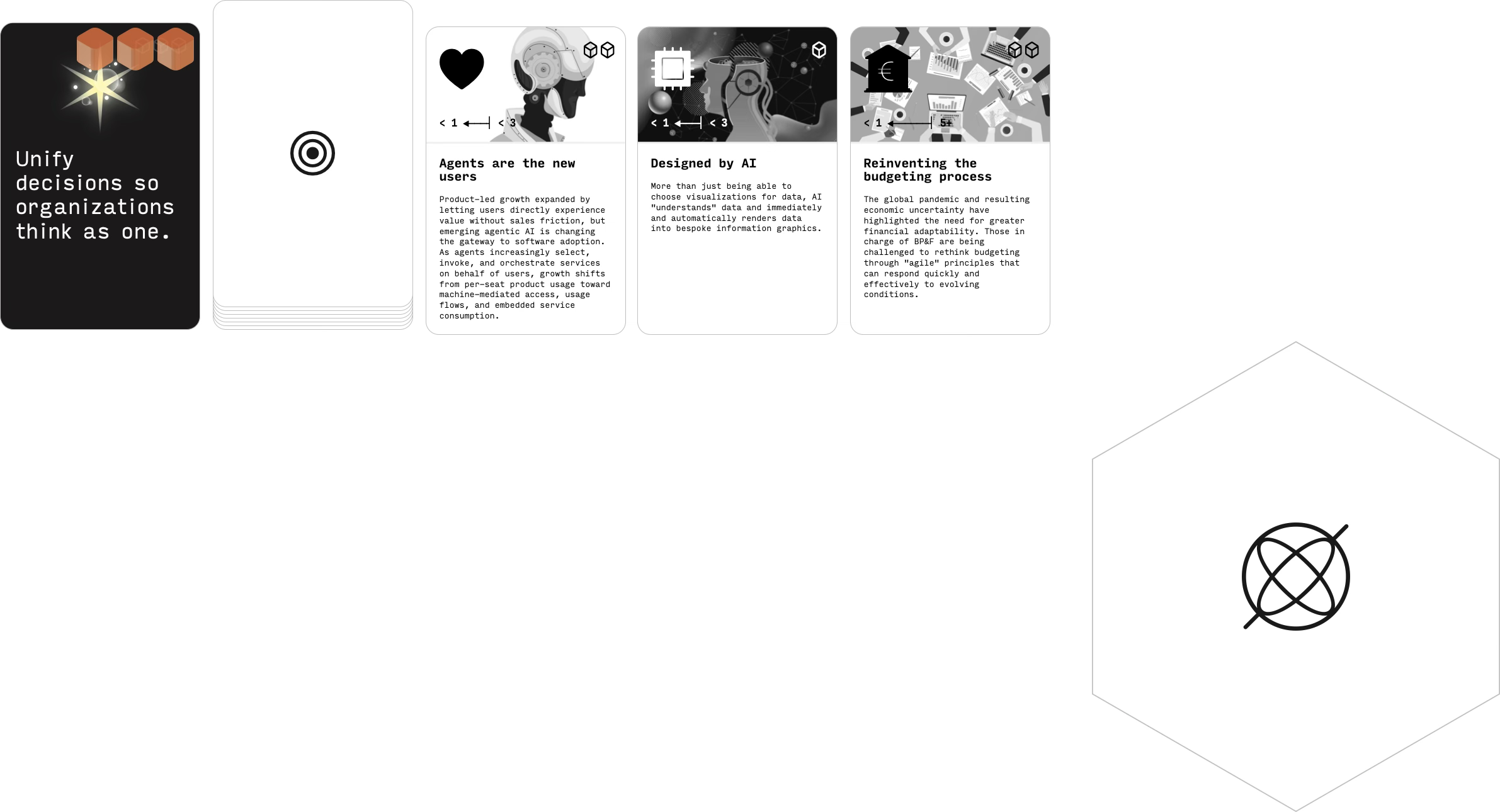
Shuffle and stack TREND cards face-down, then draw and reveal 3 TRENDS from the top of the stack. TRENDS are near-horizon SIGNALS with current impact.
|
Signal codexOur perpetually growing Codex of TRENDS and SIGNALS covers 15 domains across 10 industries, and are curated for the unique challenges and goals of each organization. Explore the codex › |
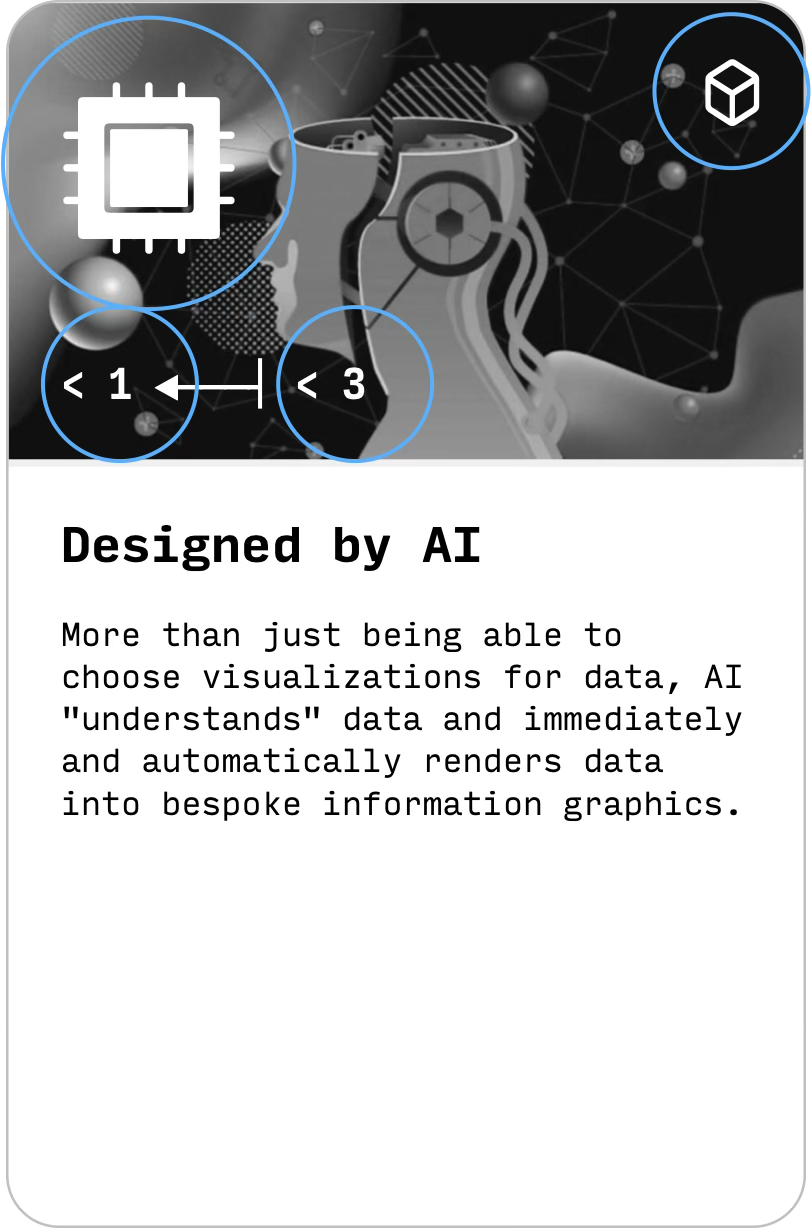
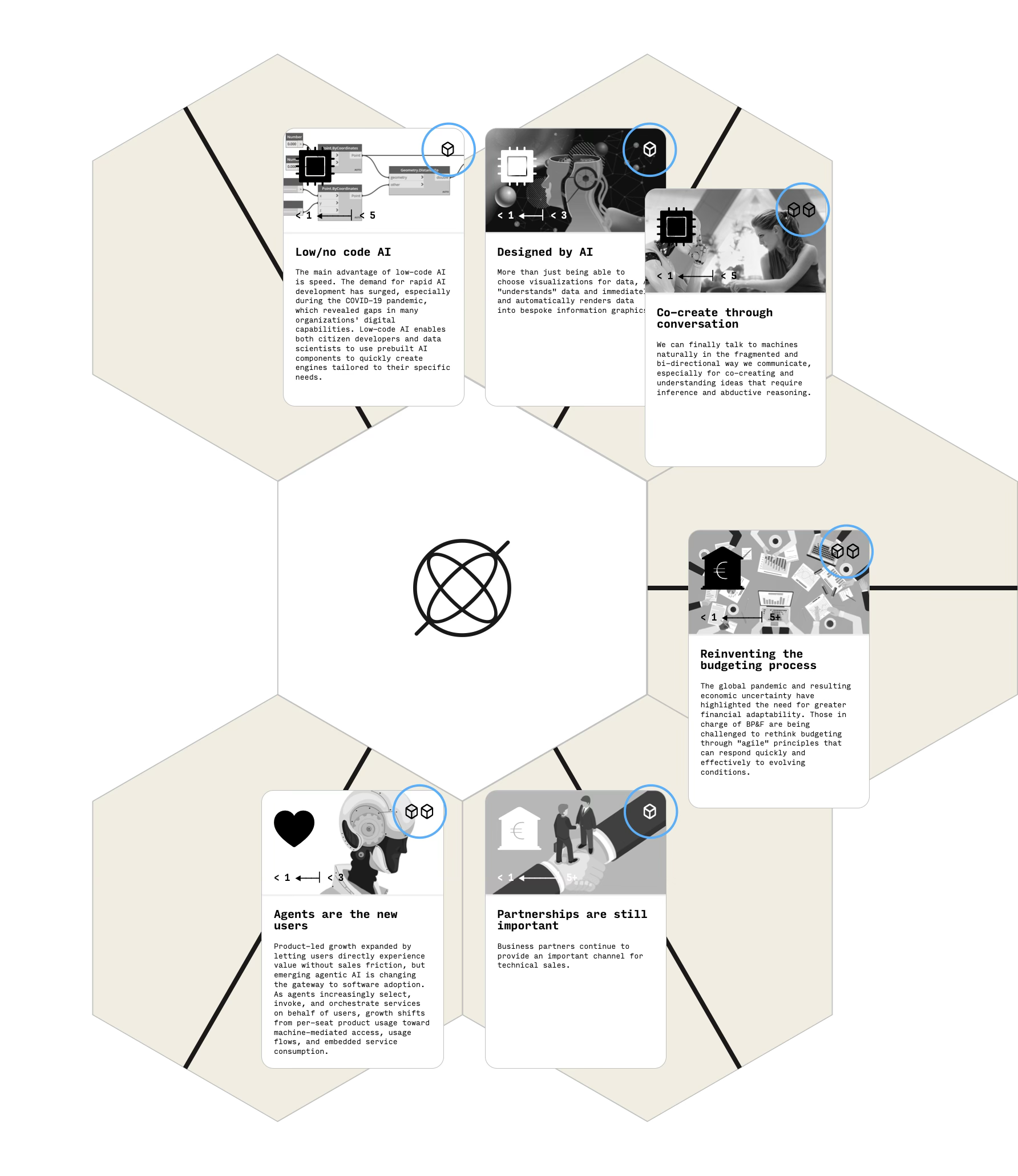
Each TREND uses a symbol for its primary impact. These can be either Social, Technology, Economic, Environmental, Political, or Business Value.
Its yield cost can be 1-3 RESOURCES.
And its horizon is represented by two numbers:
- When it becomes mature.
- And when it’s expected to stop yielding value, either from obsolescence, lack of differentiation, or saturation.
|
Assumptions
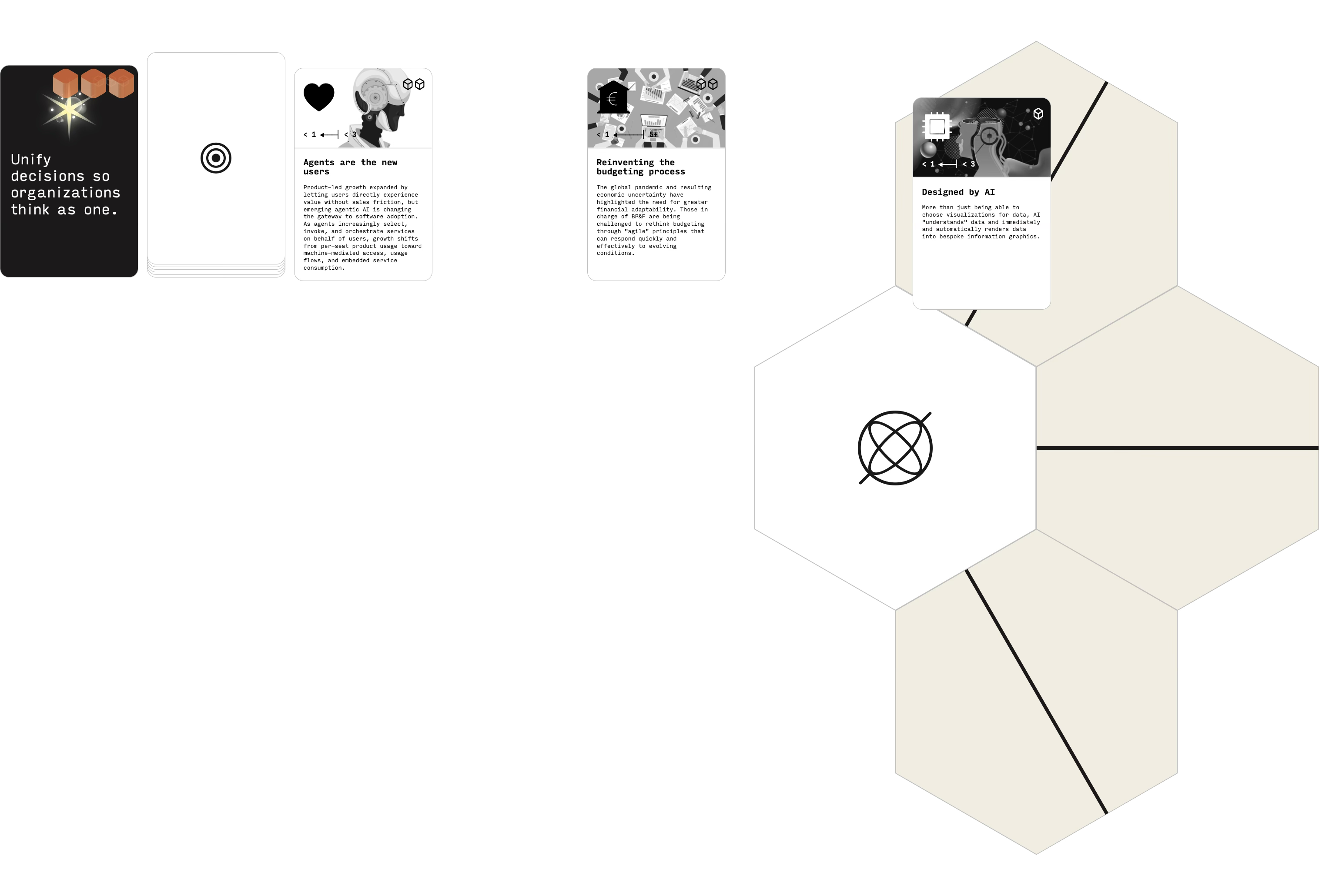
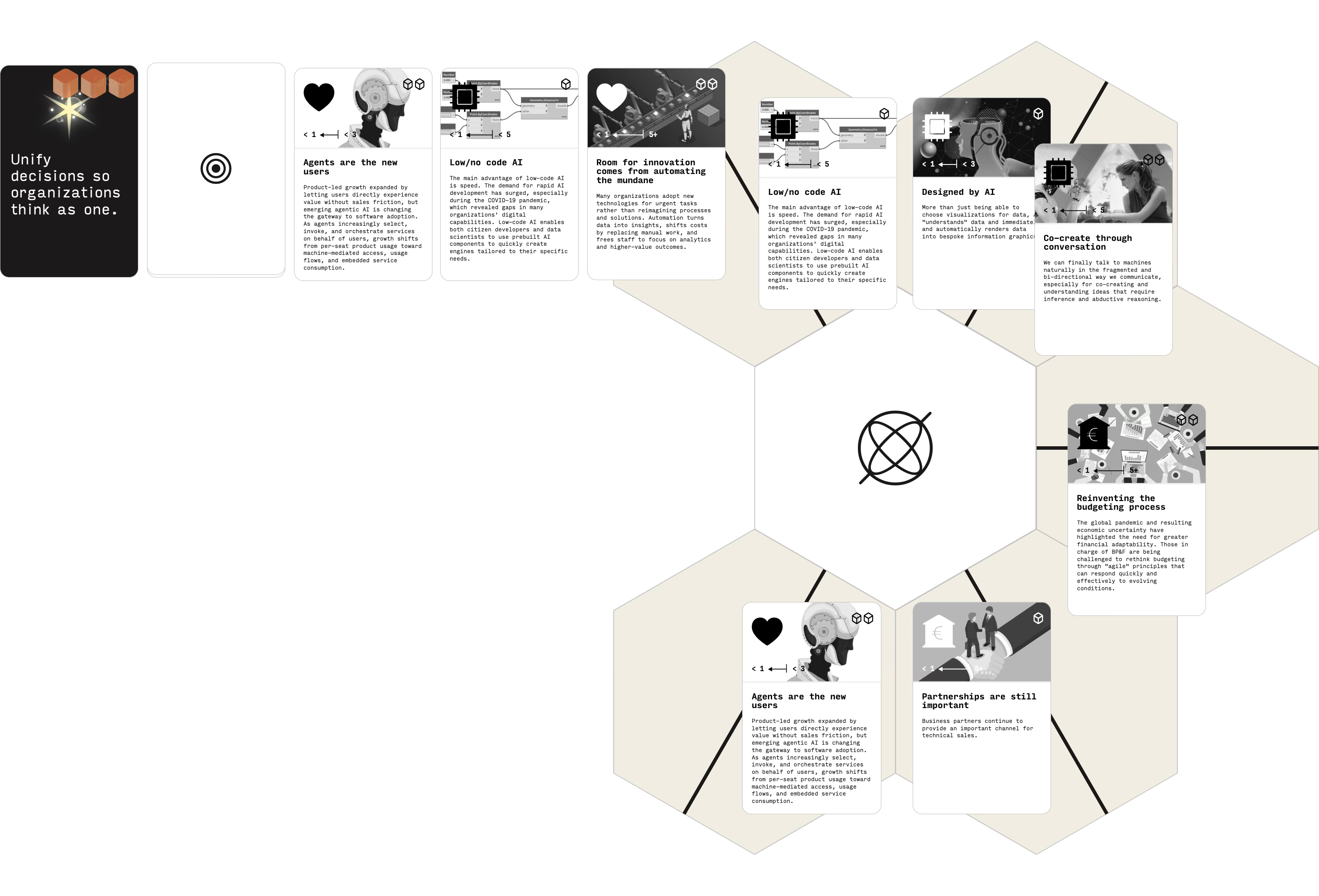
Each participant takes turns selecting a TREND with implications to their existing strategy, and placing it on a PATH tile around the PIVOT.
Participants can inquire and discuss additional researched information on a TREND’s patterns, implications, counter-trends, and potential future trajectories.
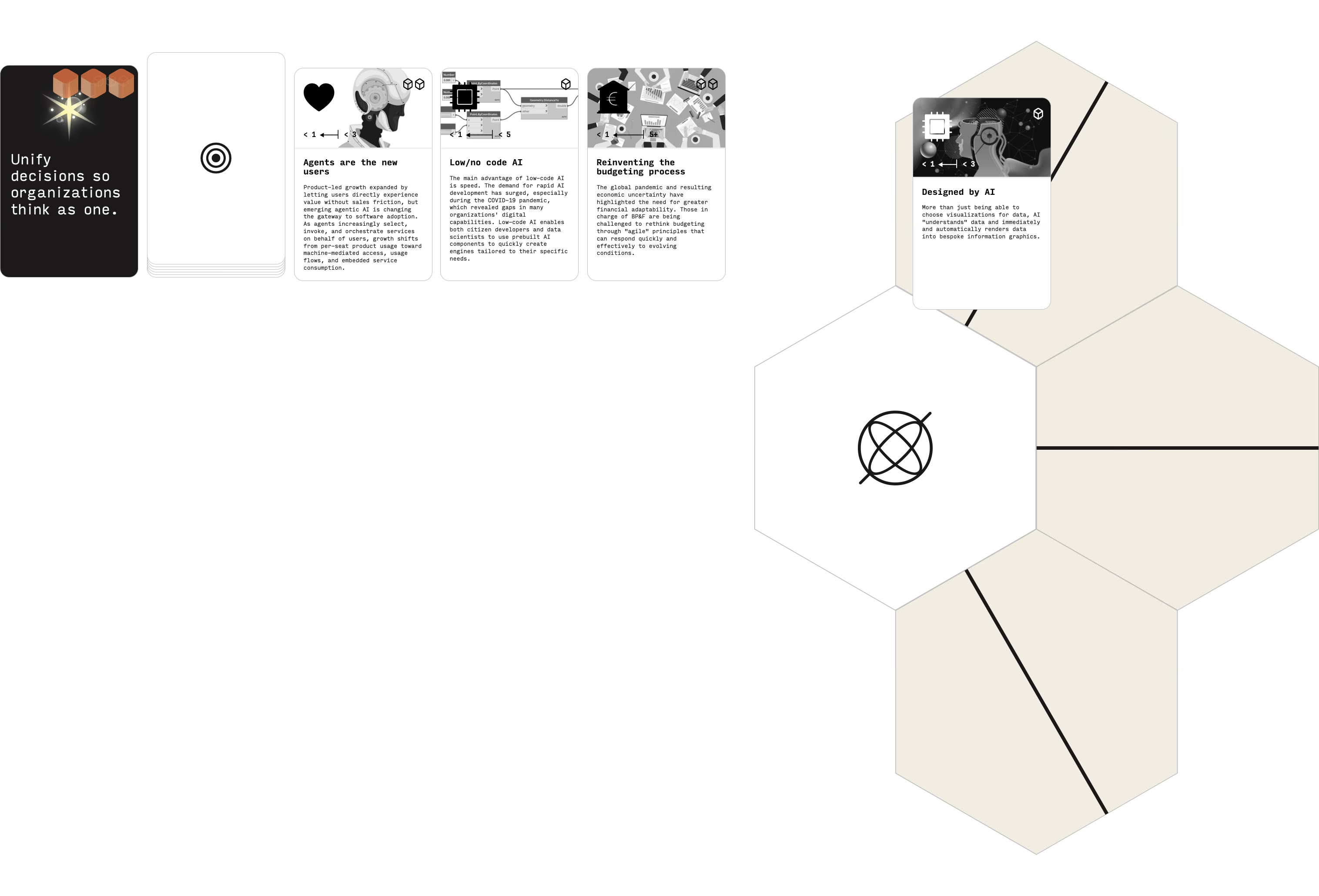
Draw and replace each selected TREND with another one from the top of the deck.
|
|
Continue selecting TRENDS this way, or removing TRENDS without implications to the organization, until participants decide all relevant TRENDS have been selected, keeping TRENDS with related patterns or implications together.
These are your organization’s current ASSUMPTIONS. The total yield cost is the deficit in initial value. This deficit is subtracted from the finishing value.
|
|
Measure
Every turn then leads with Measuring the trajectories of TRENDS and SIGNALS. This determines which are converted to CUSTOMERS, and the size of that segment.
Turn year
Use the white D6 to show the turn year. The game begins at year 1 with the team’s current ASSUMPTIONS, and advances by 1 year each turn.
|
Resolve trajectories
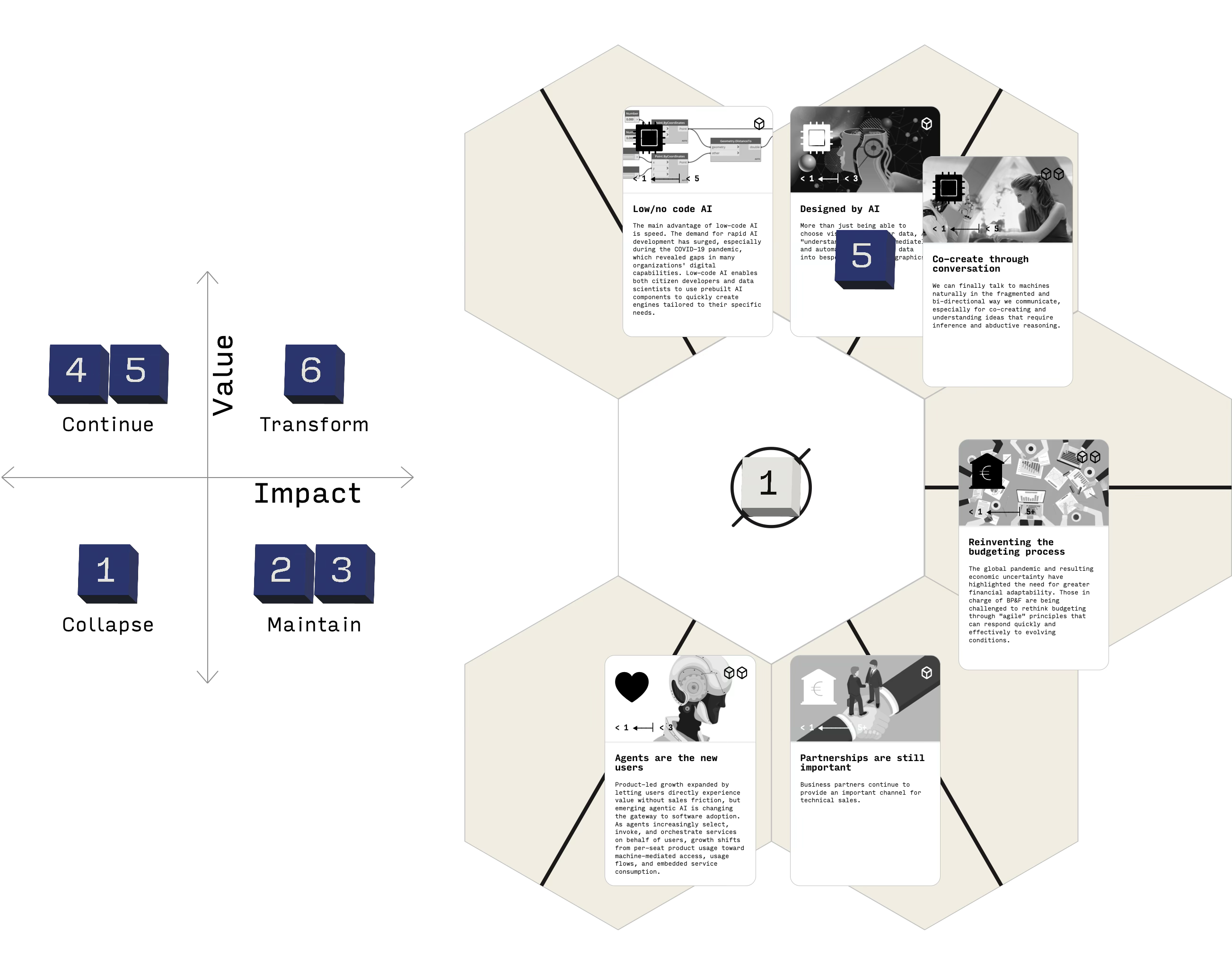
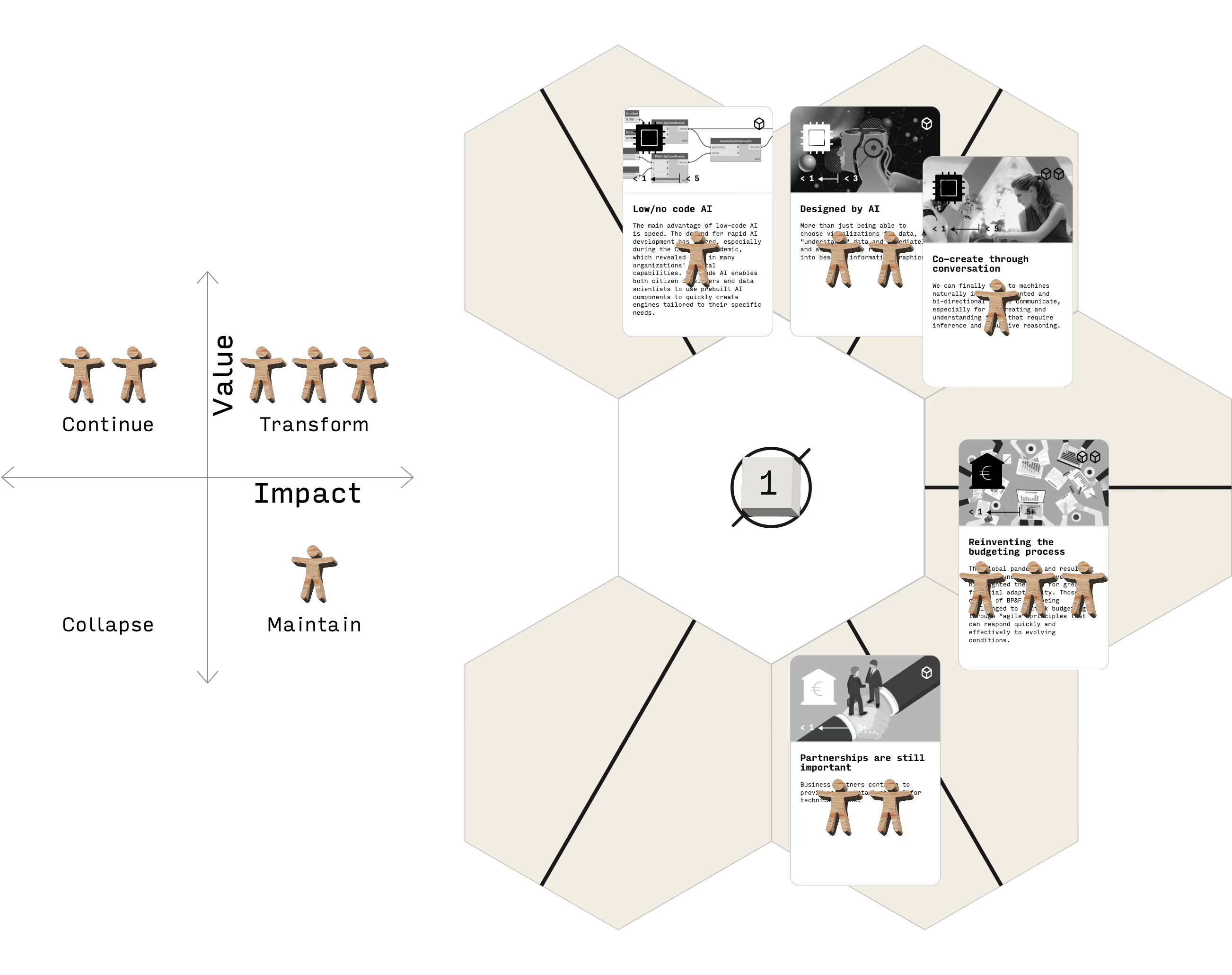
Every TREND and SIGNAL has the potential to Transform, Continue, Maintain, or Collapse, depending on whether its value and impact are increasing or decreasing from uncertain market forces.
At the year it matures, roll a blue D6 to determine which trajectory those market forces take each TREND or SIGNAL using the following resolution:
- 6 = Transform
- 4, 5 = Continue
- 2, 3 = Maintain
- 1 = Collapse
|
Convert customers
The trajectory determines the size of the CUSTOMER segment. Place CUSTOMERS on measured SIGNALS using the following conversion:
- Transform = 3
- Continue = 2
- Maintain = 1
- Collapse = 0
|
Yield
Each measured TREND and SIGNAL can then yield value in the form of RESOURCES.
Value
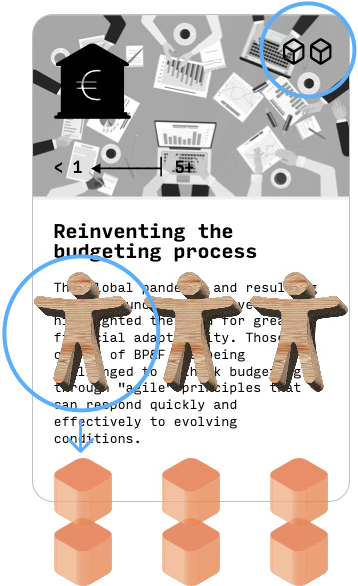
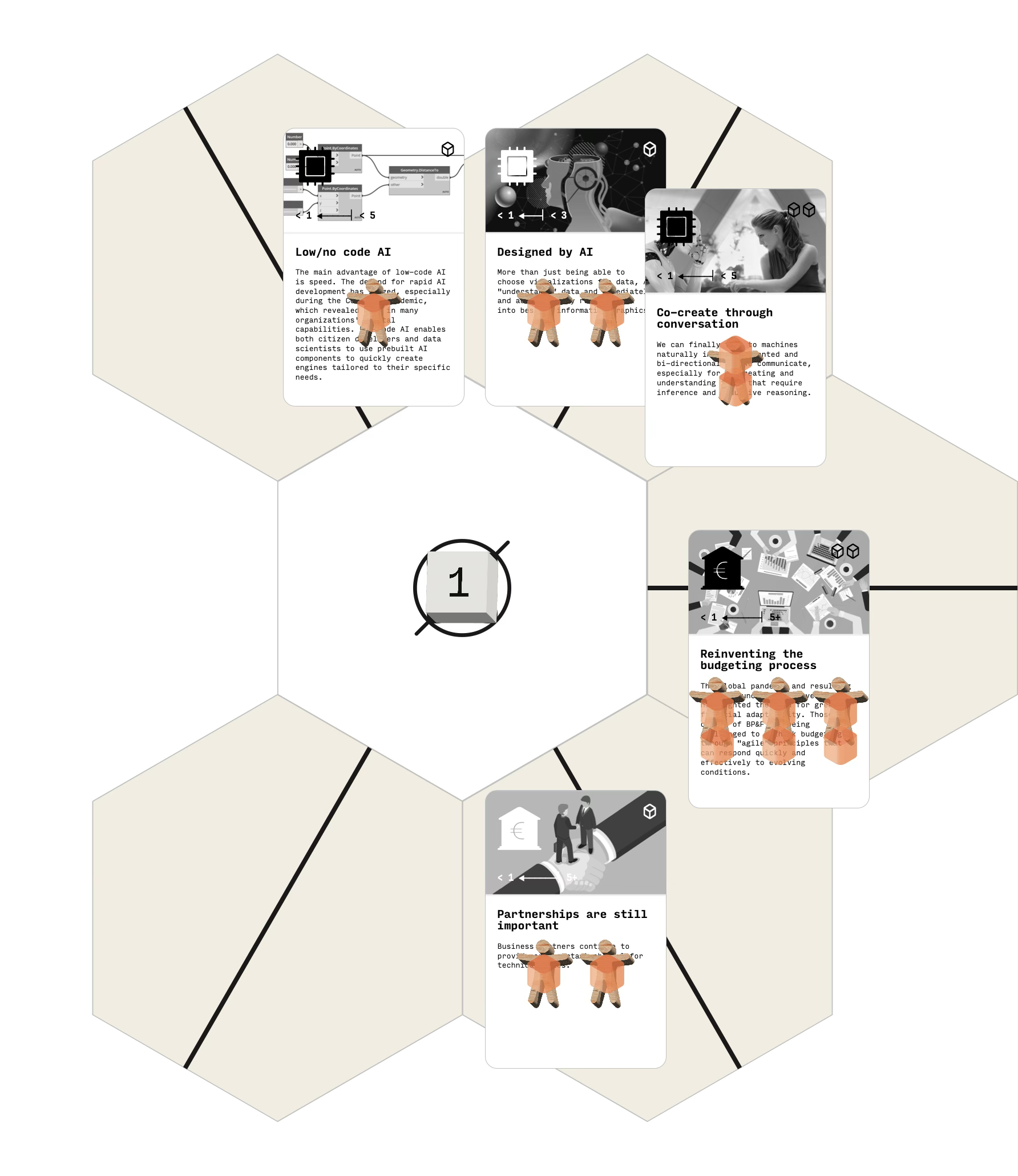
Every turn during its horizon between maturity to decay, each CUSTOMER produces RESOURCES equivalent to the SIGNAL’s yield cost.
However this value is only extracted by CAPABILITIES built next to the TREND or SIGNAL. Since CAPABILITIES for current ASSUMPTIONS should already exist on the PIVOT, RESOURCES can be extracted from these CUSTOMERS.
|
|
Predict
Participants then Predict emerging SIGNALS that have implications to their industry and domain. Since every TREND and SIGNAL eventually stops yielding value by the end of its horizon, ongoing value must eventually be derived from the future impact of emerging SIGNALS.
Emerging signals
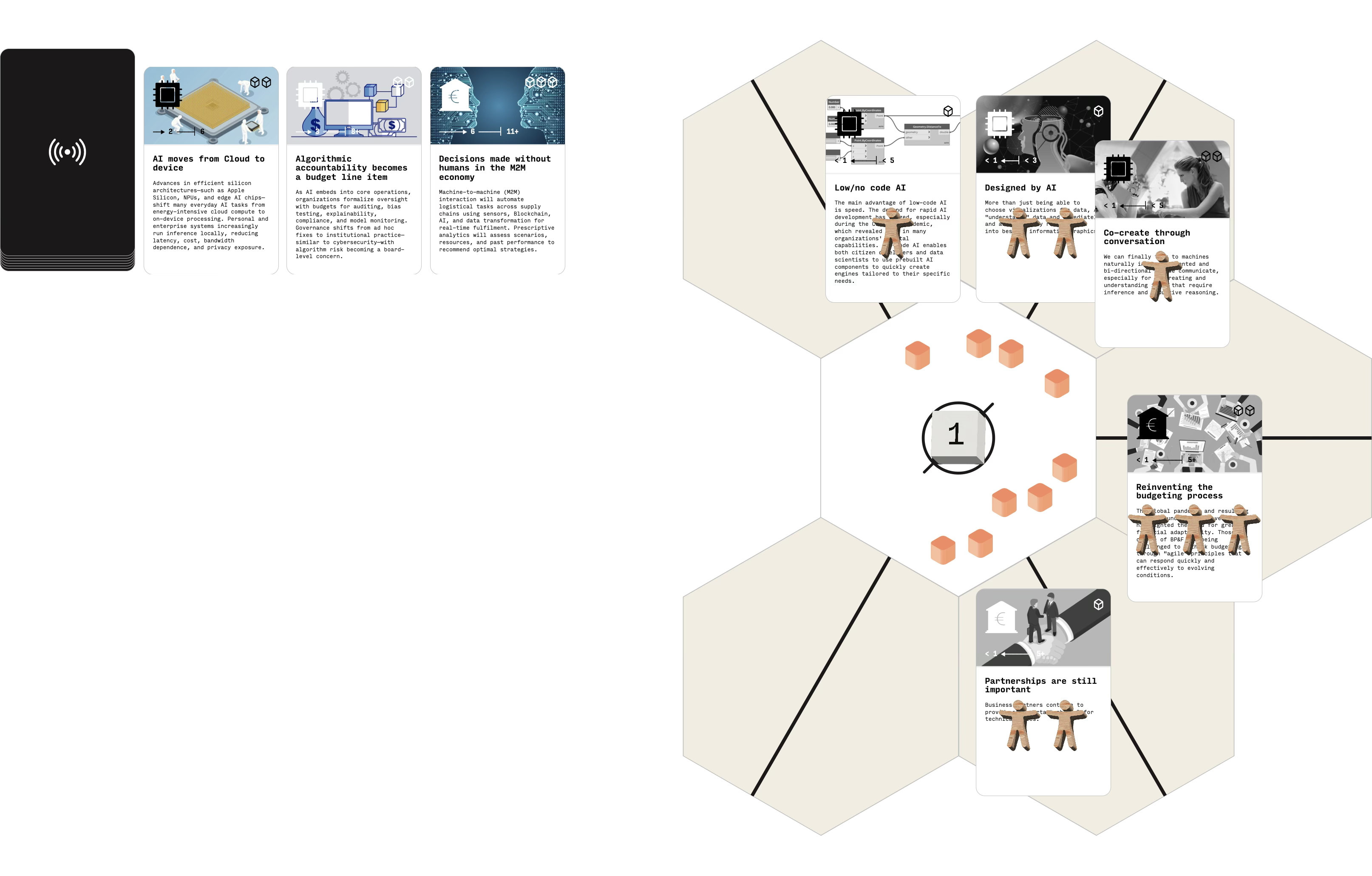
Draw and reveal 3 cards from the SIGNALS deck.
SIGNALS are derived from observable patterns that have an impact on horizons in 2 or more years.
|
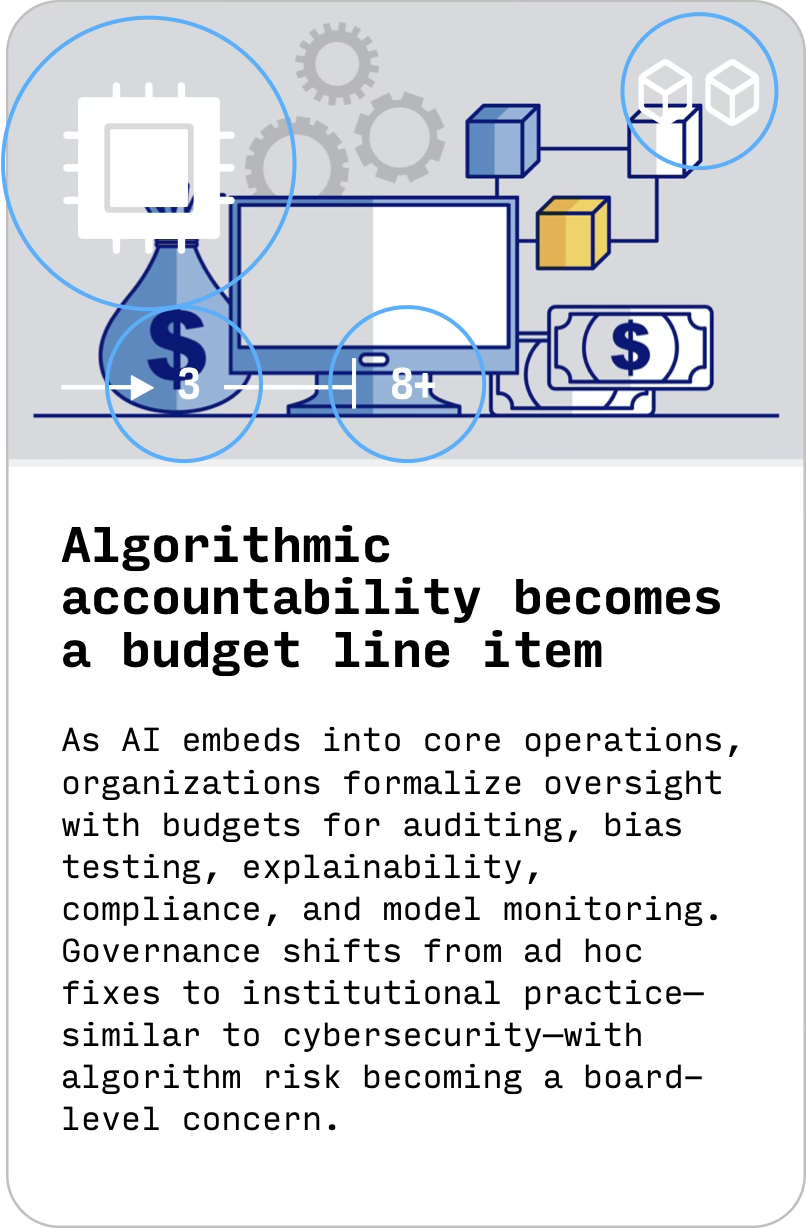
Each SIGNAL also uses a symbol for its primary impact on Social, Technology, Economic, Environmental, Political, or Business Value.
It's yield cost is 1-3 RESOURCES.
And its horizon shows:
- When it becomes mature…
- And when it’s expected to stop yielding value.
|
Predictions
Participants take turns selecting SIGNALS. However, unlike TRENDS, SIGNALS require risking RESOURCES.
Participants can inquire and discuss additional researched information on a SIGNAL’s patterns, implications, counter-trends, and potential future trajectories.
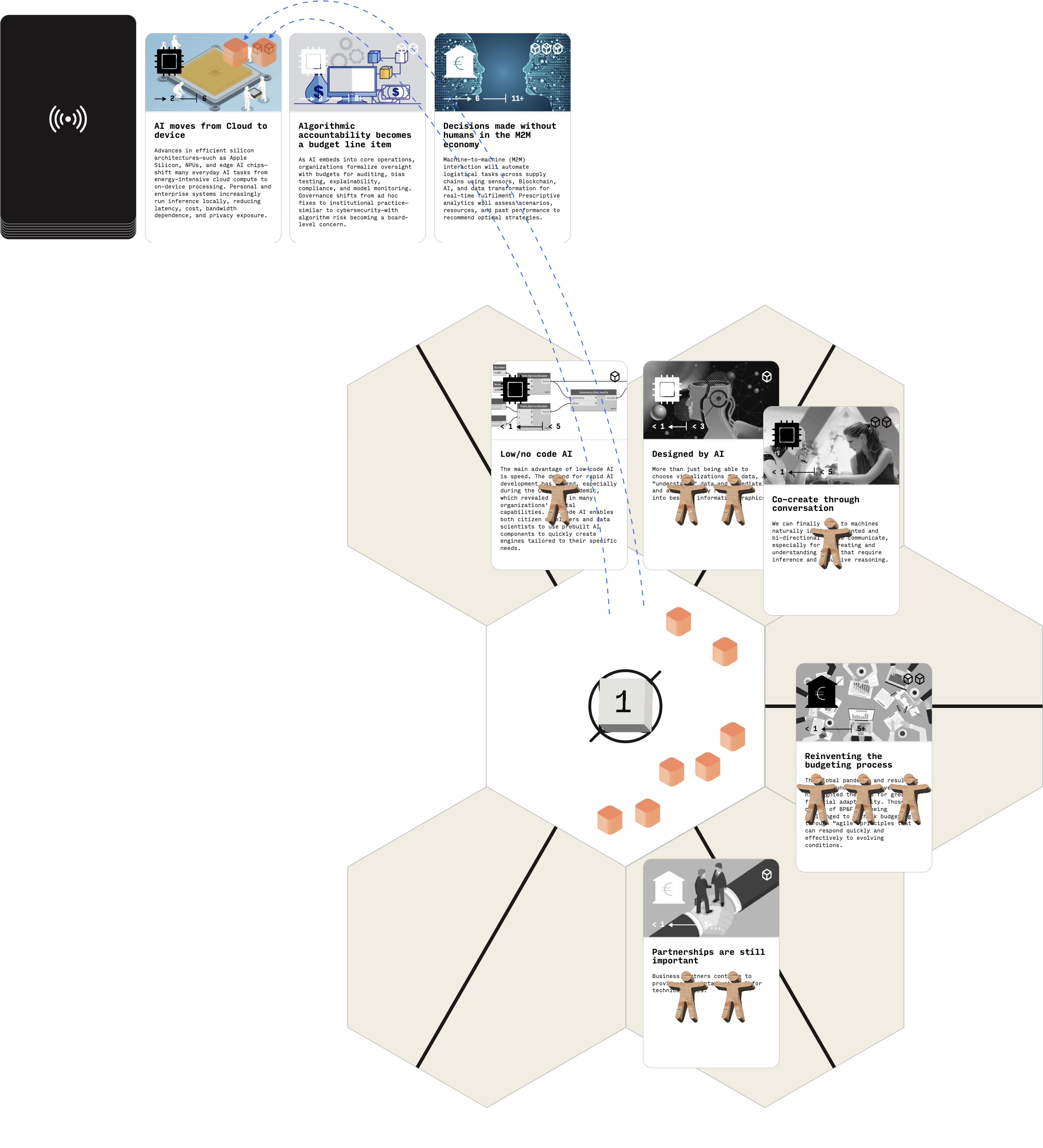
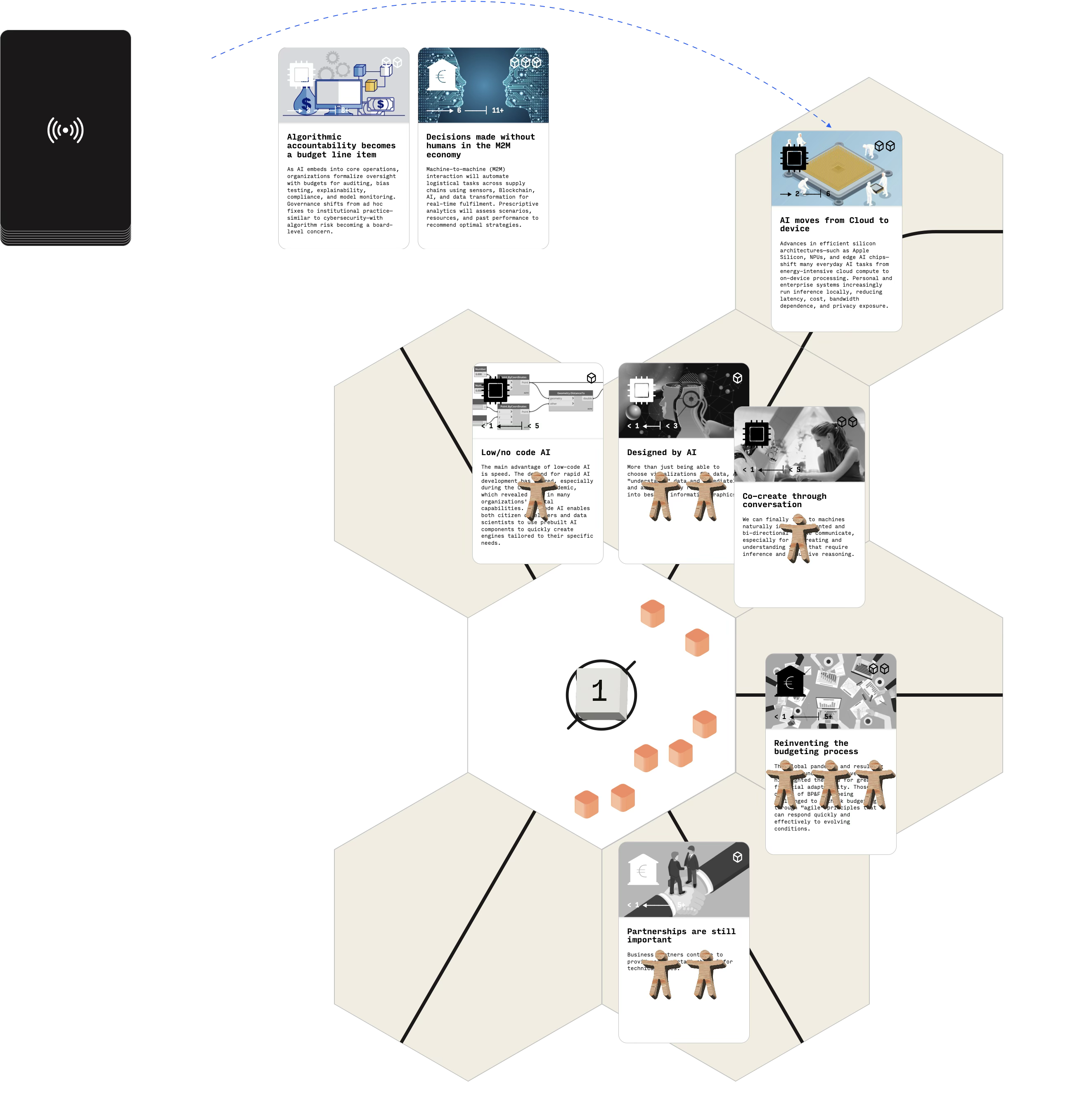
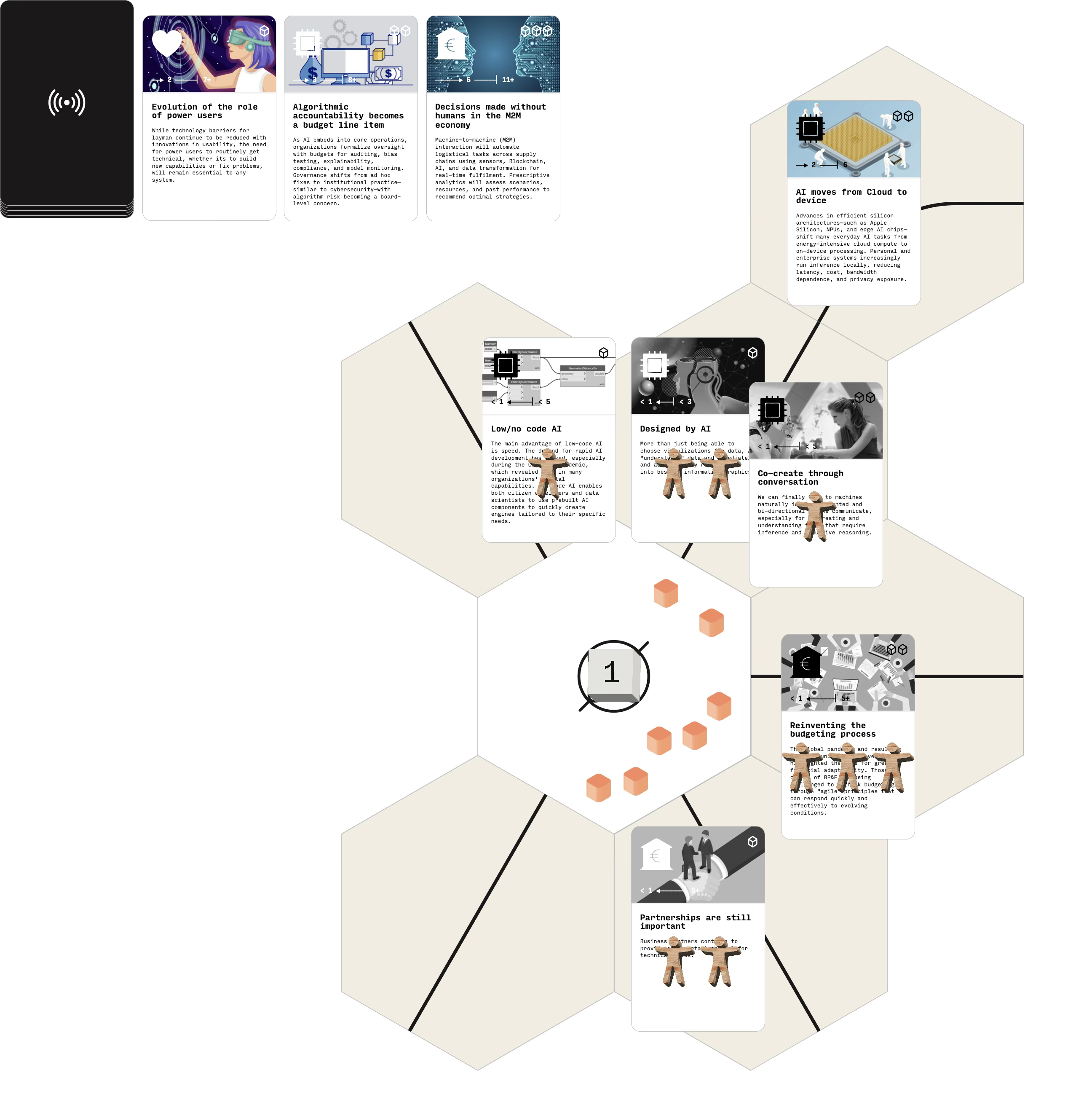
Place the SIGNAL on a PATH tile extending from the PIVOT to the year it matures, with each PATH tile extending for one year.
Replace each selected SIGNAL with another one from the deck.
|
|
|
Continue selecting and placing SIGNALS, or removing SIGNALS without implications to the organization, until participants decide to halt spending.
SIGNALS that have not been measured yet require RESOURCES for their yield cost each turn to remain on the map, or they must be removed. SIGNALS only become permanent after they are measured and converted to CUSTOMERS.
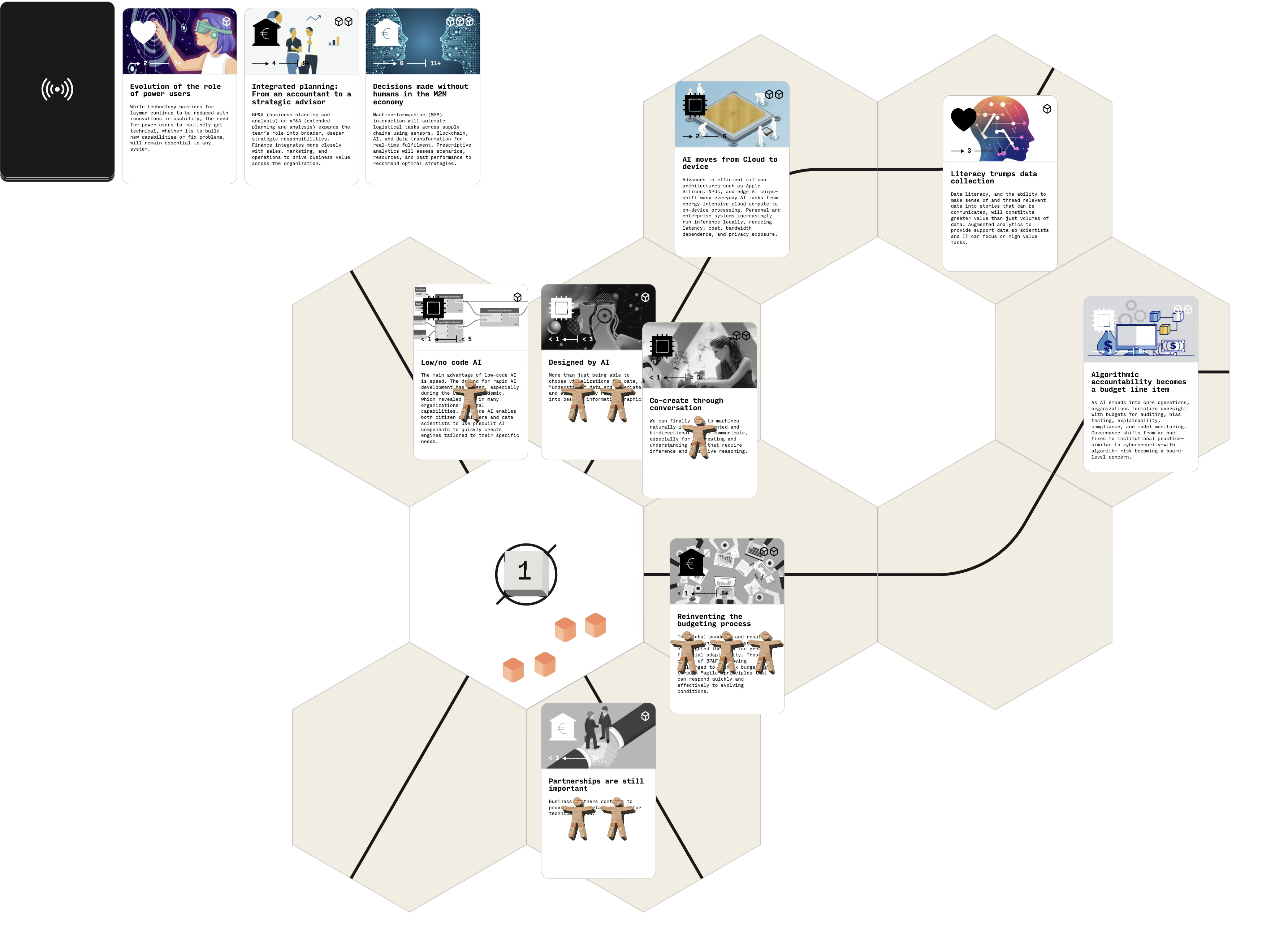
|
Build
As a temporal map of emerging SIGNALS forms, participants can cooperatively Build strategic areas of CONFIDENCE, ALIGNMENT, and CAPABILITIES.
Strategic areas
Strategic AREAS are between PATHS where several SIGNALS converge.
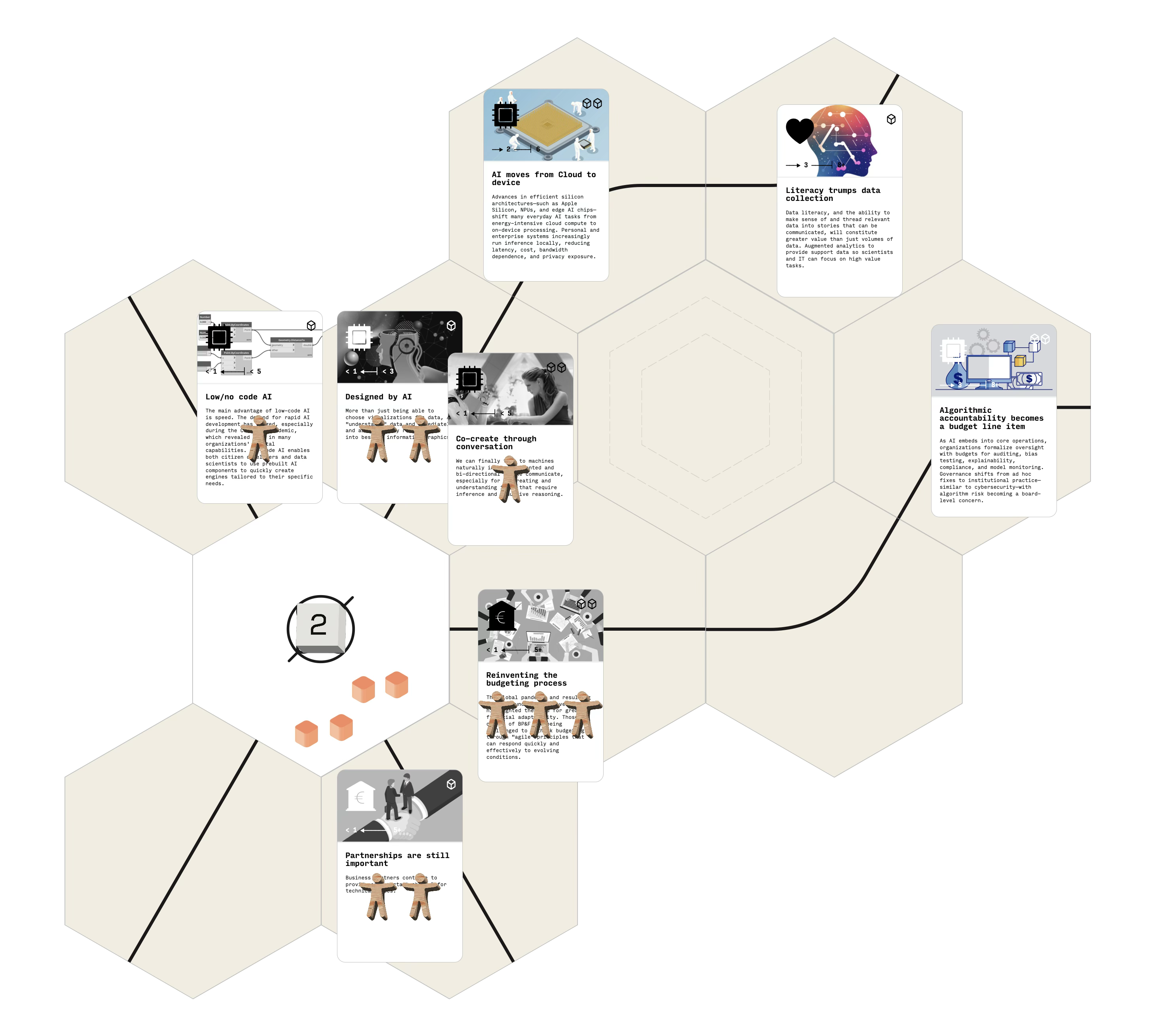
|
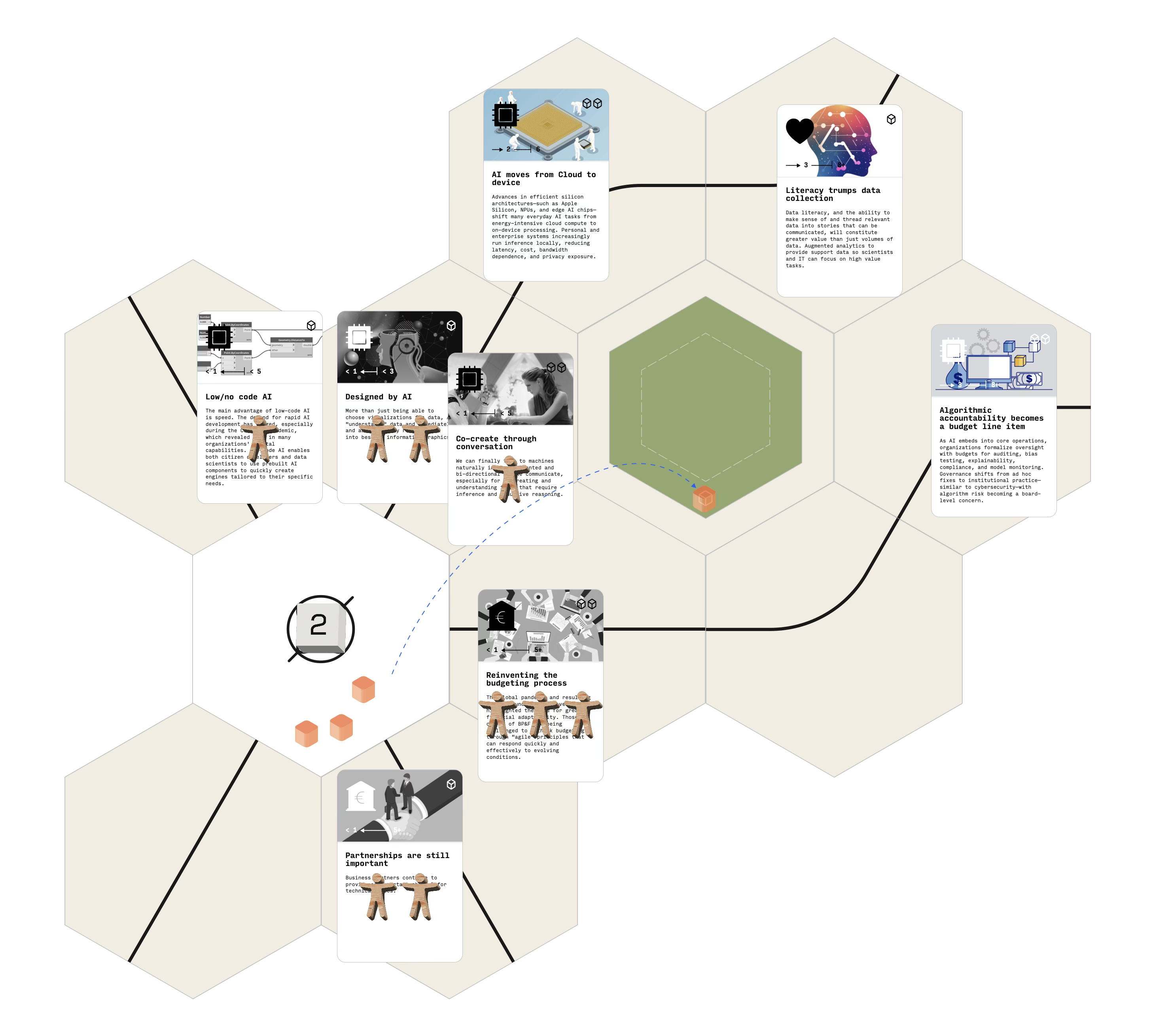
Confidence
Individual participants can stack CONFIDENCE tokens on an AREA tile using 1 RESOURCE each.
|
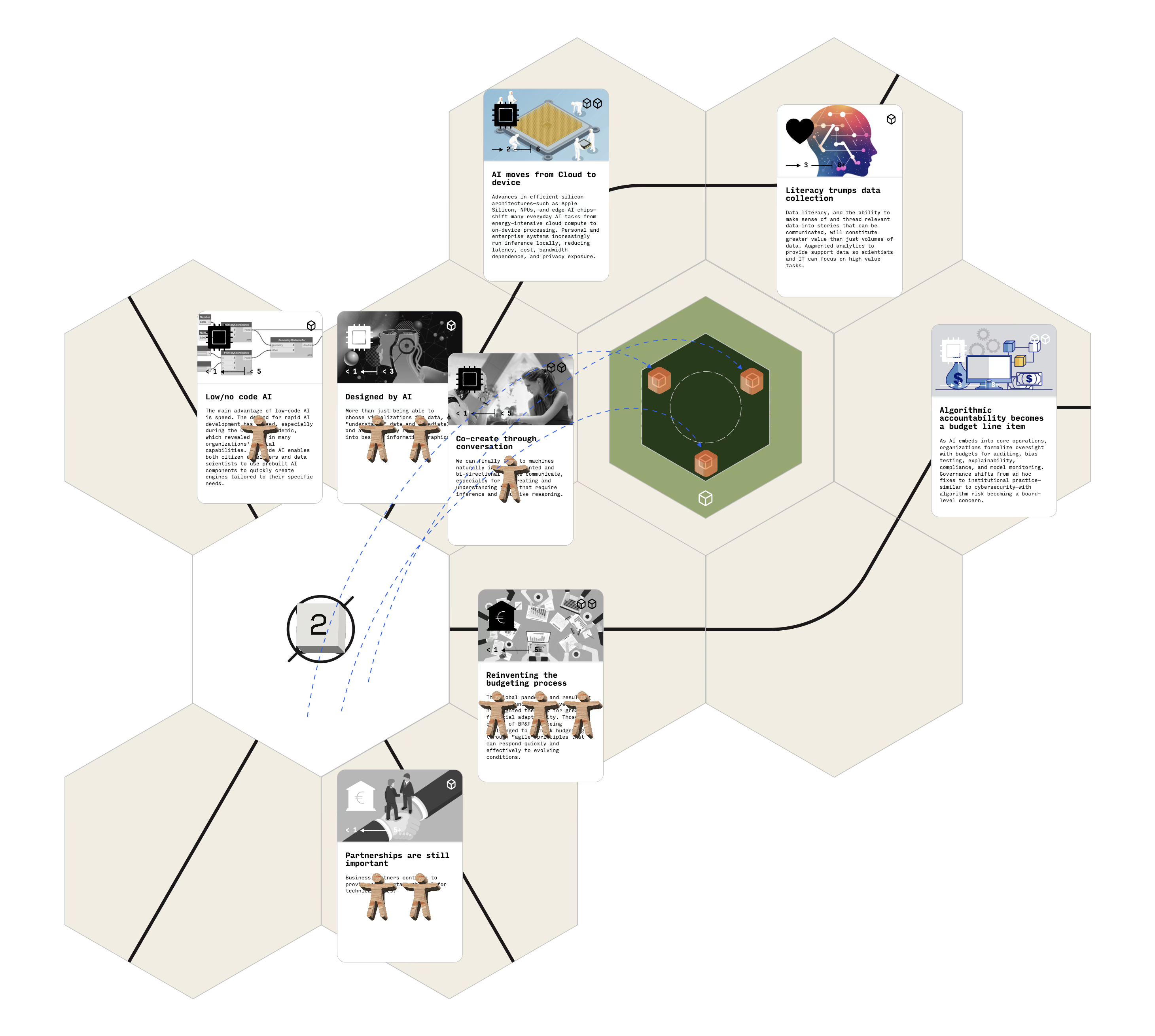
Alignment
If groups of 3 participants are aligned, they can also stack ALIGNMENT tokens for 3 RESOURCES each.
|
Capabilities
When participants have finished building, or when they exhaust their RESOURCES, the game advances to the next turn, measuring the trajectories and CUSTOMER conversion of SIGNALS that mature in that year.
As the game progresses, a topology of SIGNALS, PATHS, and strategic AREAS emerges as a representation of the decision landscape.
Where CONFIDENCE and ALIGNMENT intersect, participants can explore building new CAPABILITIES for 1 RESOURCE each, that target surrounding CUSTOMERS.
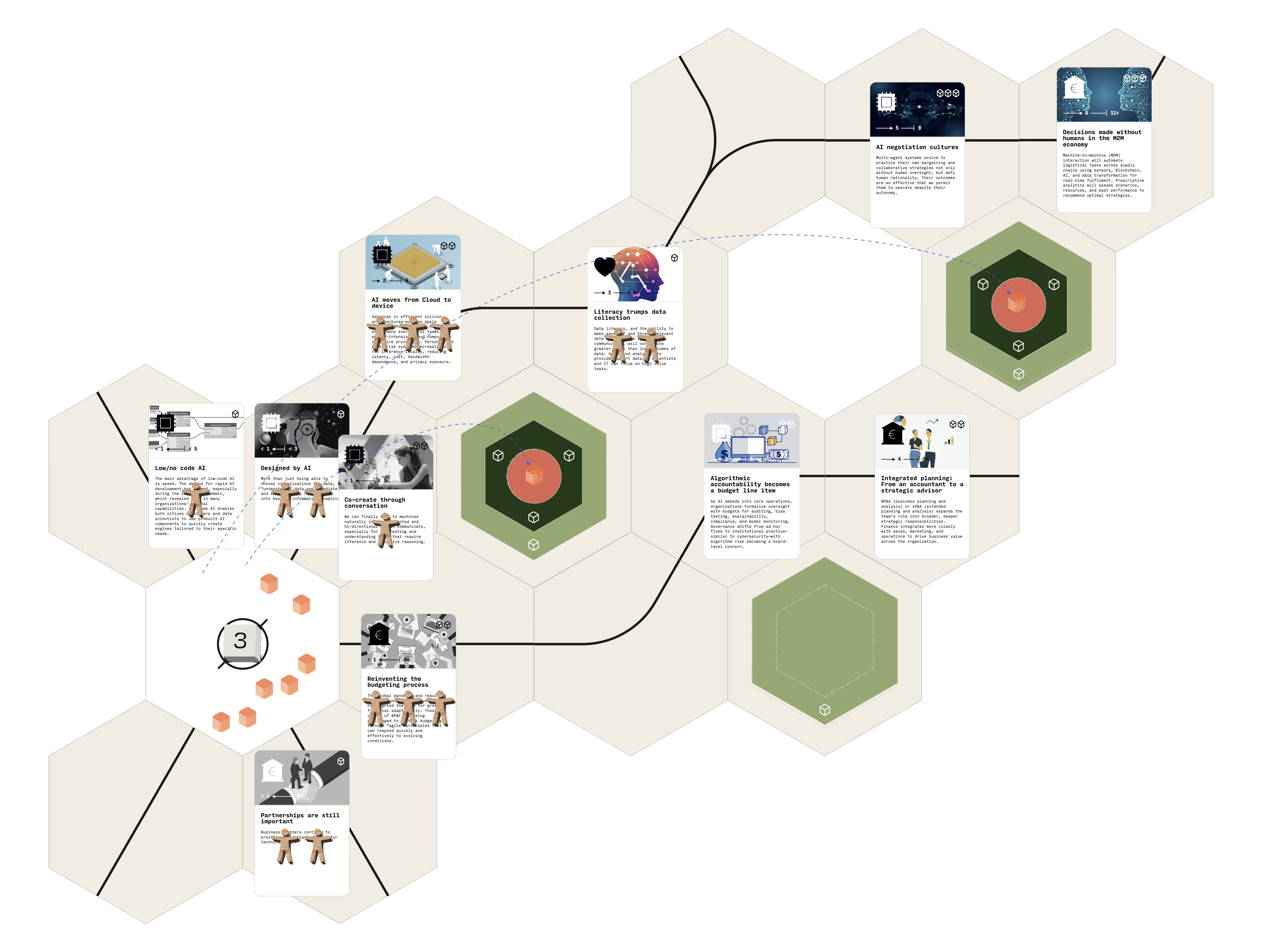
|
Mission integrityIf at least 3 PARTICIPANTS agree that a new CAPABILITY demonstrates a particularly strong affiliation toward their organization’s MISSION, they can use that RESOURCE to recover lost MISSION integrity. 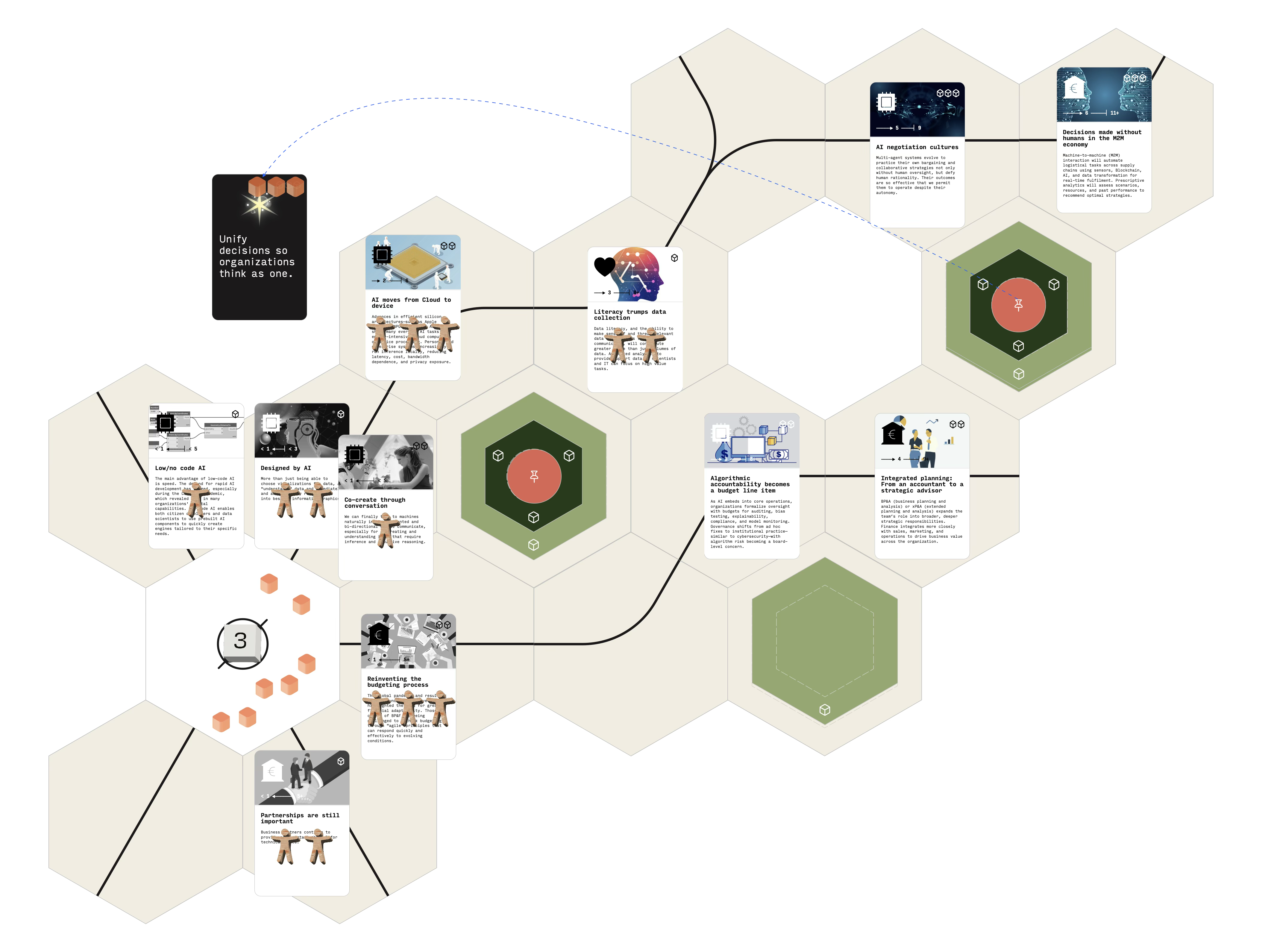
|
Extracting resources
CAPABILITIES are necessary for extracting RESOURCES yielded by CUSTOMERS from surrounding SIGNALS within their horizons.
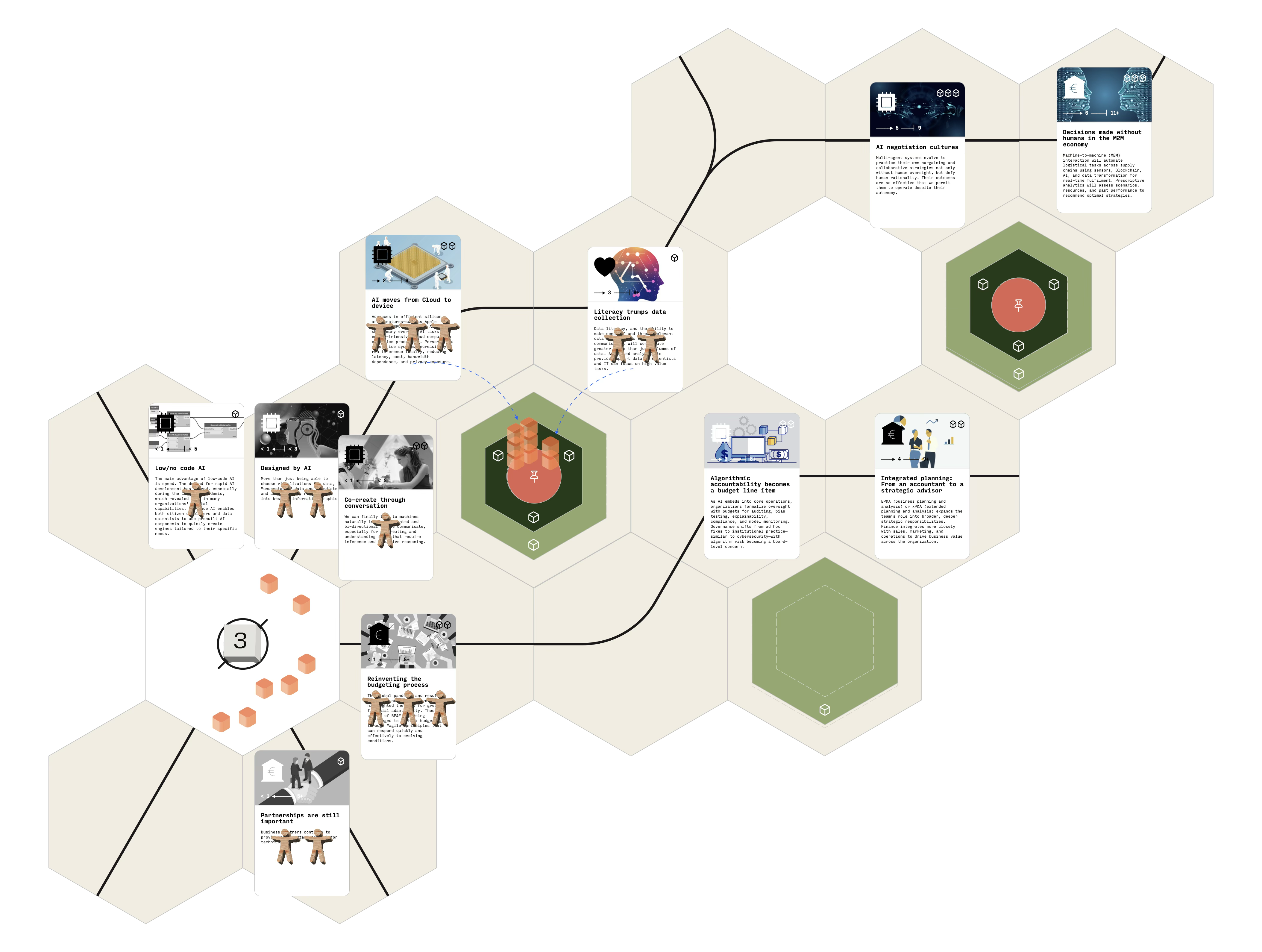
|
CAPABILITIES require 1 RESOURCE each per turn to maintain, otherwise they deprecate and are removed from the map.
Evaluate
The game finishes either after:
- A pre-determined number of turns, with each turn representing a year of operation
- A series of CAPABILITIES are built that form a cohesive strategic roadmap
The organization’s POSTURE is then evaluated.
Posture
The organizational POSTURE is shaped by 4 dimensions—value, alignment, confidence, and impact—calculated through our scorecard from the topology of the decision landscape into high, medium, or low for each dimension.
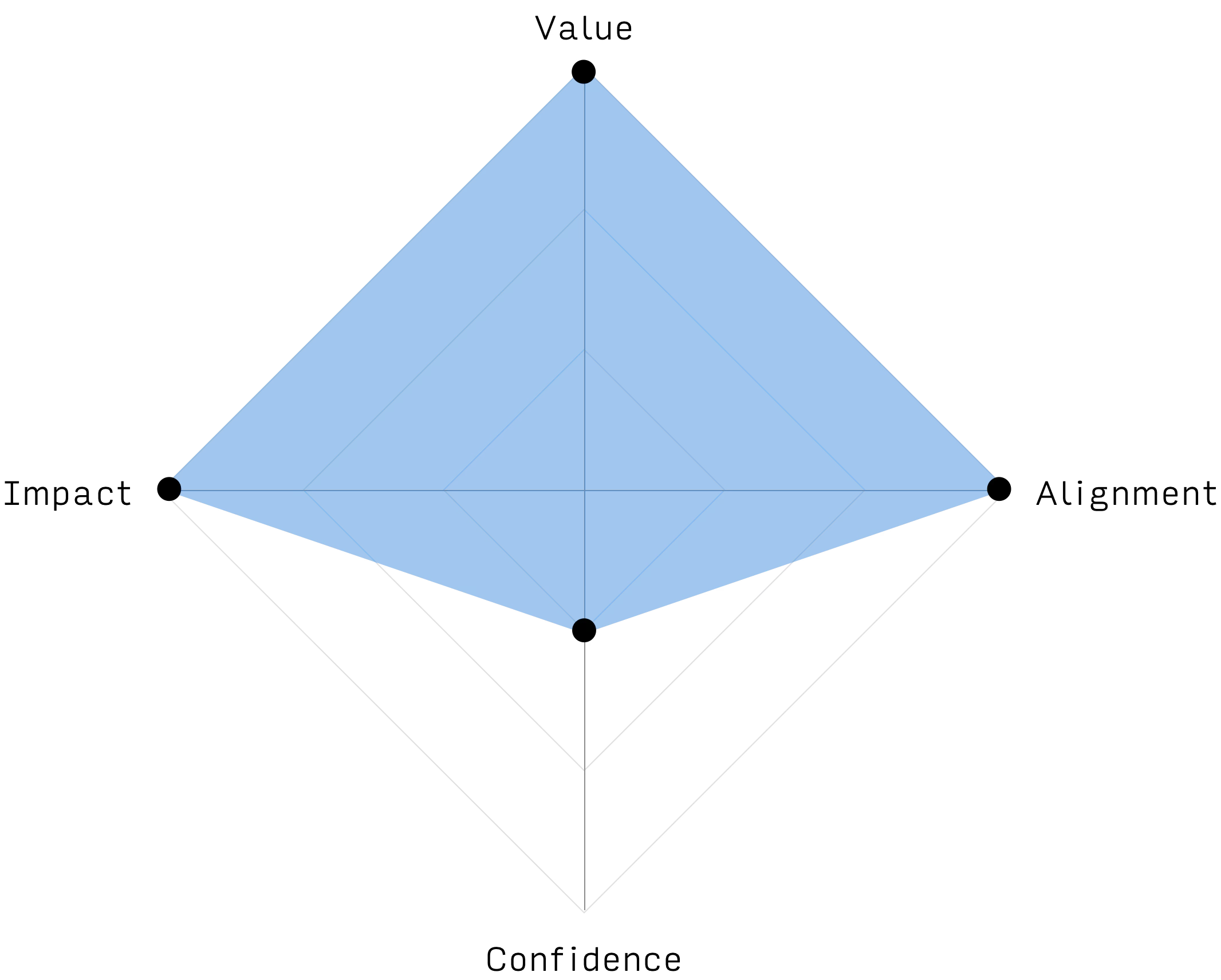
|
Archetypes
POSTURES can be described by 6 archetypes.

Adaptive leaderFlourishing Strong organization, coherent, externally constructive, but confidence remains calibrated. This is your healthiest balanced posture. |

Efficient incumbentSurviving Stable, disciplined, reliable, but not highly transformative. This posture optimizes continuity. |

Overconfident giantExpanding Economically strong, but confidence outruns coherence. This posture often appears successful while accumulating hidden fragility. |

Fragmented innovatorExperimenting Creative activity exists, but coherence is weak. Confidence is unstable because fragmentation usually produces inconsistent conviction. This is important. |

Brittle extractorCollapsing Weakest posture. Low resilience across all dimensions. This should be visually unmistakable. |

Transformational catalystRedefining This posture represents the rare case where:
The crucial difference from Overconfident Giant is:
That is what stabilizes elevated confidence. |
Turn-by-turn metrics
Turn-by-turn metrics are later synthesized into a POSTURE journey that provides further insight into:
- Change and adaptability to plausible future conditions
- Tolerance to decision risks
- And readiness and resilience of capabilities